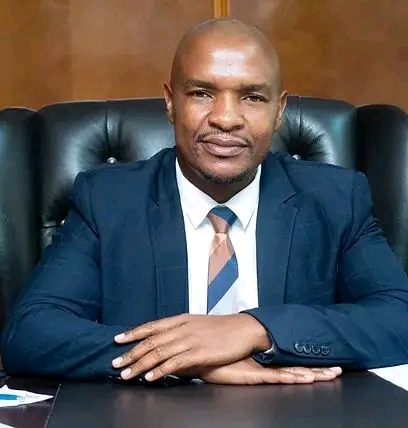
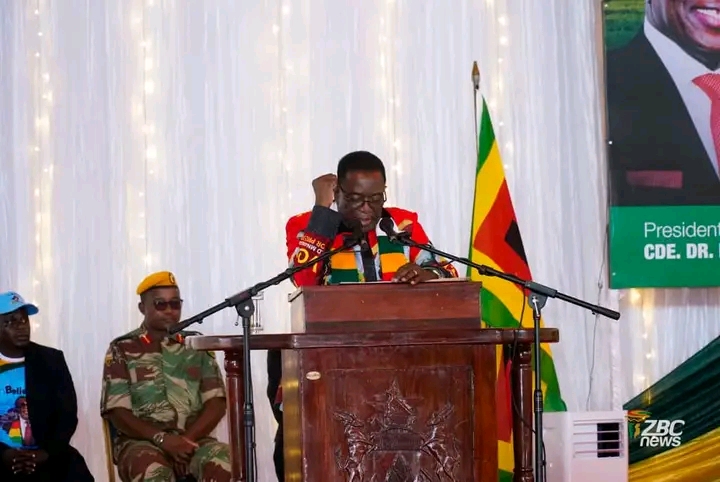
Vice President Kembo Mohadi, flanked by Special Advisor to the President Cde Joram Gumbo (right) and United Nations Resident and Humanitarian Coordinator Mr. Edward Kallon (left), poses for a group photo with Dr. Martin Rushwaya and other senior government officials following the official opening of MEL Awareness Week.
By Donald Chakamanga
Vice President Kembo Mohadi officially opened the Monitoring, Evaluation and Learning (MEL) Awareness Week this Thursday at a local hotel, calling for the institutionalisation of MEL systems across all sectors to accelerate Zimbabwe’s developmental goals and combat corruption.
The event, attended by over 250 delegates from government ministries, departments, the private sector, civil society, and academia, marks a pivotal moment in the country’s drive toward evidence-based governance.
MEL Week, which runs from 28 July to 1 August 2025, is a key platform for promoting transparency, results-based management, and accountability within Zimbabwe’s development agenda.
In his keynote address, Vice President Mohadi underscored the critical role MEL systems play in tracking progress under the National Development Strategy 1 (NDS1) and in shaping the forthcoming NDS2.
“MEL enables us to monitor implementation, allocate resources efficiently, and respond more effectively to the needs of our people,” he said.
He also warned that corruption—whether in the public or private sector—remains a serious threat to national progress, calling for collective action and integrity-driven leadership.
President Emmerson Mnangagwa delivered a pre-recorded video message that was broadcast during the event, encouraging stakeholders to embrace MEL as a fundamental tool for economic growth and policy effectiveness.
“Without rigorous monitoring and evaluation, our development efforts risk failure,” the President said, reaffirming his administration’s commitment to data-driven governance and Vision 2030.
Chief Secretary to the President and Cabinet, Dr. Martin Rushwaya, described MEL as the “heartbeat” of government operations, essential for aligning policies with national priorities and ensuring a culture of continuous improvement.
Also in attendance was the United Nations Resident and Humanitarian Coordinator, Mr. Edward Kallon, who commended Zimbabwe for its leadership in resourcing and mainstreaming MEL systems. He noted that such commitment is rarely seen elsewhere and is crucial for achieving the Sustainable Development Goals (SDGs), particularly in areas such as health, education, gender equality, water access, and poverty reduction.
“MEL is not just a technical tool—it is the backbone of good governance,” Kallon said. “Development must be driven by data.”
Zimbabwe’s quest to attain upper middle-income status by 2030 hinges on bold, accountable, and evidence-based decision-making. Through mainstreaming robust Monitoring, Evaluation and Learning systems across all levels of governance and development, Zimbabwe strengthens its capacity to deliver tangible results, curb corruption, and ensure that every dollar spent drives progress toward inclusive, sustainable growth.