By Dickson Bandera
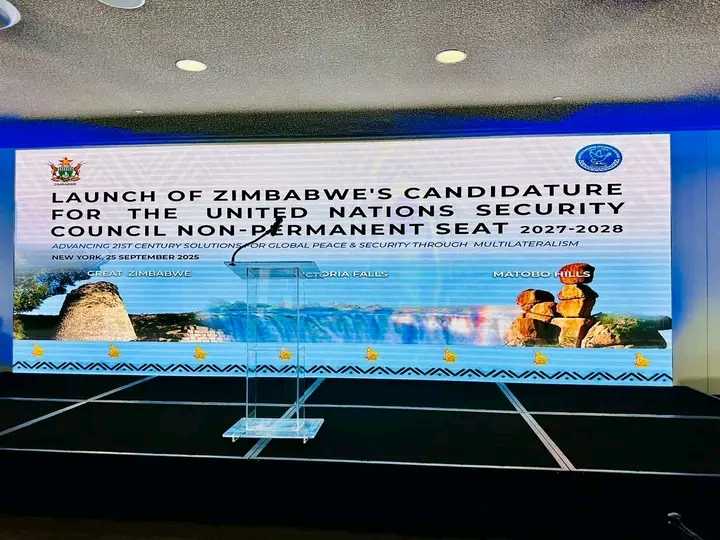
With just four months remaining before the United Nations General Assembly meets in New York, where member states will elect five non-permanent members to the 15-member Security Council, Zimbabwe is intensifying efforts to secure a seat on the United Nations Security Council.
The election is scheduled for 3 June 2026, and Harare is positioning its candidature as both a national obligation and a continental responsibility, anchored in Africa’s collective aspirations for stronger representation in global governance.
The UNSC is the United Nations’ most powerful organ, mandated to maintain international peace and security. It comprises 15 members: five permanent members — China, France, Russia, the United Kingdom and the United States — who hold veto power, and 10 non-permanent members elected for two-year terms on a regional basis.
Africa holds three non-permanent seats, allocated through rotation among the continent’s five sub-regions. To be elected, countries must secure a two-thirds majority in the General Assembly and may not serve consecutive terms.
Zimbabwe has already secured formal endorsements from the African Union (AU) and the Southern African Development Community (SADC), a critical milestone that signals regional consensus and significantly strengthens its bid.
As diplomatic lobbying gathers momentum ahead of the June vote, Zimbabwe is presenting itself as a principled, predictable and bridge-building candidate, seeking to use a non-permanent seat to amplify African priorities while contributing constructively to international peace and security decision-making.
Harare says its campaign is rooted in Africa’s long-standing call for equitable representation within the Security Council, where the continent remains structurally underrepresented despite being the focus of a substantial share of Council deliberations, peacekeeping operations and sanctions regimes.
The government has framed the bid as an opportunity to advance African priorities through multilateral engagement, while also contributing meaningfully to the maintenance of international peace and security.
Under the theme:
“Advancing 21st Century Solutions for Global Peace and Security through Multilateralism,” Zimbabwe’s priorities at the Council include conflict prevention and the peaceful resolution of disputes, support for the African Union’s Silencing the Guns initiative, counter-terrorism and the prevention of violent extremism. It also seeks strengthened cooperation between the United Nations and regional organisations, post-conflict reconstruction and sustainable development, and the promotion of the Women, Peace and Security agenda.
Harare has also pledged to remain attentive to the concerns of Small Island Developing States and other vulnerable nations, particularly with regard to climate-related security risks.
Although non-permanent members do not possess veto power, they play a critical role in shaping resolutions, peacekeeping mandates, sanctions regimes and thematic debates within the Council.
Zimbabwe’s Track Record at the Council
Zimbabwe argues that its candidature is reinforced by prior experience and institutional memory, having served twice before as a non-permanent member during the 1983–1984 and 1991–1992 terms.
During those periods, Zimbabwe participated in Council deliberations on Cold War-era tensions, African liberation struggles and post-conflict reconstruction, earning a reputation for consensus-building and principled diplomacy.
The government says this experience positions Zimbabwe to make an immediate and informed contribution if elected again.
Peacekeeping Credentials
Central to Zimbabwe’s campaign is its long-standing participation in United Nations peacekeeping operations. Over the decades, Zimbabwe has deployed military and civilian personnel to missions in Angola, the Democratic Republic of Congo, Somalia, Sierra Leone, Liberia, Sudan, South Sudan and Timor-Leste.
Officials argue that countries which consistently contribute troops and resources to peacekeeping efforts should have a voice in shaping Security Council mandates, rules of engagement and post-conflict strategies.
Who Zimbabwe Is Competing With
While African candidacies are generally harmonised through AU processes to avoid split votes, competition remains intense across regions for the limited non-permanent seats. Countries from Latin America, Eastern Europe and Asia are also campaigning for the five available slots in the 2027–2028 cycle.
Within Africa, states that have recently served or are currently serving on the Council include Gabon, Ghana, Kenya, Mozambique and South Africa, highlighting the rotational nature of African representation and the importance of continuity.
African Experience on the Council
Several African countries have served multiple terms as non-permanent members, including Nigeria, South Africa, Egypt, Algeria, Ethiopia, Senegal, Tanzania, Uganda, Zambia and Libya. While these states have helped shape debates on African conflicts, sanctions and peacekeeping, their influence has remained time-bound due to the two-year term limit.
Zimbabwe argues that regular rotation should be complemented by the presence of experienced voices capable of sustaining Africa-centred initiatives beyond a single term.
A Continental Mandate
Harare maintains that its bid is not driven by narrow national interests, but by a commitment to advance African and broader Global South perspectives within the Security Council. The government says it will align its positions with AU common positions and consult widely with fellow developing nations if elected.