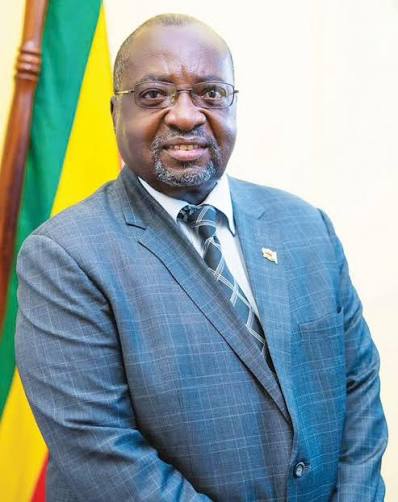
Chief Secretary to the President and Cabinet Dr Martin Rushwaya
By Dickson Bandera
HARARE, March. 26, 2026 — Government of Zimbabwe has reported significant progress in key social sectors under the Zimbabwe United Nations Sustainable Development Cooperation Framework (ZUNSDCF), while acknowledging persistent structural and financing gaps that must be addressed as the country transitions into its next development phase.
Addressing a high-level joint review meeting in Harare this Thursday, Chief Secretary to the President and Cabinet, Dr Martin Rushwaya said the engagement marked “a critical milestone” in aligning United Nations support with Zimbabwe’s national development priorities.
“This gathering is a high-level policy platform designed to ensure that the United Nations development system remains strategically synchronized with Zimbabwe’s sovereign development trajectory,” Dr Rushwaya said.

The meeting, held at the Monomotapa Hotel, brought together senior government officials, the UN family, development partners, civil society and private sector representatives to assess progress and shape the 2027–2031 cooperation framework.
Dr Rushwaya said momentum had already been built through a recent strategic prioritisation workshop, which sought to ensure that the next framework is “not merely a collection of projects, but a coherent, adaptive, and systems-based response” to national needs.

He commended the United Nations Resident Coordinator, Edward Kallon, and development partners for their role in supporting implementation, noting that “approximately 52 percent of delivery” had been achieved through joint programmes.
On development outcomes, the Chief Secretary highlighted gains in health, education and social protection, attributing them to the Government’s inclusive development approach under President Emmerson Mnangagwa.

“In 2025, essential health service coverage reached an impressive 99 percent, up from 93 percent in 2022,” he said.
“In response to the El Niño-induced drought, social protection coverage was scaled to 76 percent of the extreme poor, ensuring a resilient safety net.”
He added that the education sector had recorded “vital milestones in infant and secondary school enrolment,” signalling recovery following recent disruptions.
Dr Rushwaya said the Government had institutionalised performance contracting to drive accountability across public institutions.
“These contracts are the standard by which we measure our commitment to the people of Zimbabwe,” he said. “By rewarding excellence and addressing underperformance, we are transforming the public service into a results-driven machine.”
Despite the gains, he warned of critical imbalances and structural challenges that could hinder progress under the forthcoming National Development Strategy 2 (NDS2).

“Financing remains heavily skewed toward the ‘People’ pillar,” Dr Rushwaya said. “To succeed under NDS2, we must rebalance our focus toward Prosperity and Peace, prioritising structural transformation, aggressive industrialisation and value addition.”
He also flagged macroeconomic vulnerabilities, noting that although the economy grew by 6.6 percent in 2025, it continues to face “persistent headwinds from unsustainable public debt and high informality.”
“Our next steps must focus on formalisation and fiscal sustainability,” he said.
On inequality, Dr Rushwaya highlighted stark disparities in access to basic services.
“While urban water access stands at 93 percent, rural access remains at 48 percent,” he said. “Closing this gap is a non-negotiable priority… to ensure we truly leave no place behind.”
Looking ahead, the Chief Secretary said Government is operationalising a results-based framework for NDS2, including the introduction of a National Key Performance Indicators (KPI) Handbook and strengthened data management systems.
“The success of NDS2 hinges on our ability to move beyond planning into precise execution and measurement,” he said.
He added that stakeholder validation processes for the next cooperation cycle had been completed, ensuring the framework is “rooted in evidence and inclusive of all voices.”
“The task before us today is not merely a technical exercise; it is a strategic opportunity to shape the future of our nation,” Dr Rushwaya said.
The meeting comes as Zimbabwe intensifies efforts to align international cooperation with its Vision 2030 agenda, which seeks to achieve upper middle-income economy status through inclusive growth and institutional reforms.