By Brenda Mazhambe
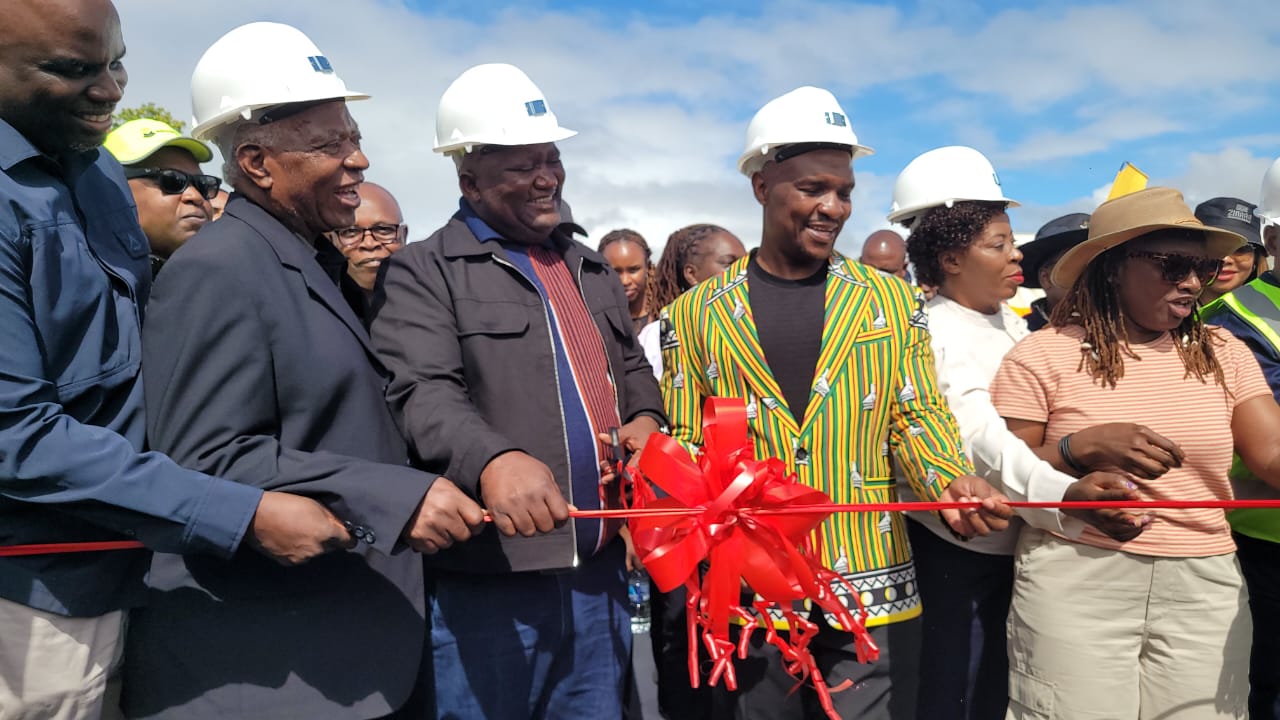
The Ministry of Transport and Infrastructural Development marked yet another significant milestone with the commissioning of the Mucheke River Bridge this Thursday, in a vibrant ceremony that brought together community members, government officials, key stakeholders, and contractors in a shared celebration of progress and connectivity.
The Mucheke Bridge forms part of the broader Harare–Beitbridge Rehabilitation Project, under which approximately 550km of road have so far been upgraded. The project is being implemented by five contractors strategically deployed along different sections of this vital national corridor, widely regarded as the country’s economic lifeline.
Speaking at the official opening ceremony, Minister of Transport and Infrastructural Development, Hon. Felix Mhona, expressed satisfaction with the steady progress being made under the Second Republic, underscoring the strategic importance of the project in easing congestion, improving road safety, and enhancing the efficient movement of goods and people along one of the country’s busiest transport routes.
“Today marks another major milestone following the commissioning of the Manyame River Bridge earlier this week. We are excited as we continue to connect not only nations, but our people, ensuring ease of movement and improved trafficability,” said Minister Mhona.
The Minister noted that the newly commissioned bridge will have an immediate and meaningful impact on daily commuters who have long endured heavy traffic congestion, particularly during peak hours.
“To the people of Mucheke, this development will decongest traffic as we have been witnessing long queues, whether coming to work or going home. This bridge enhances traffic flow and improves the overall transport experience,” he noted.
The commissioning comes at a time when the Ministry has intensified nationwide infrastructure delivery, with multiple projects being rolled out simultaneously as part of a coordinated and accelerated development programme.
Among the flagship undertakings is the Mabvuku Interchange Construction Project, now at an advanced stage, alongside the Msasa Interchange under a dual-infrastructure strategy aimed at improving traffic flow, reducing congestion, and enhancing freight efficiency along the Beira Corridor. Once completed, these interchanges are expected to significantly reduce travel times and strengthen regional logistics performance.
In March, Government commissioned the rehabilitated Lorraine Drive in Harare and opened it to traffic. The preceding month also saw the opening of the Harare Drive section between Simon Mazorodze and Willowvale Road, extending from Chinzou Roundabout—further easing pressure on key urban arteries.
Elsewhere, the Bulawayo–Kezi–Maphisa and Gwanda–Maphisa roads were upgraded and maintained ahead of the successful hosting of the Independence Anniversary Celebrations on 18 April in Maphisa. Approximately 120km of roadway benefited from these works, strengthening regional connectivity and accessibility.
The Bulawayo–Victoria Falls Road Rehabilitation and Widening Project continues to stand out as one of Government’s flagship infrastructure programmes, with 57km already completed. In April, a further 5.3km section in the Insuza area was opened to traffic, reflecting sustained momentum on this strategic route linking Zimbabwe to one of its key tourism corridors.
Significant progress has also been recorded on the Bulawayo–Nkayi Road, where over 70km has been completed out of the 160km stretch, improving mobility and economic linkages between key communities.
In Harare, the Chiremba Road corridor—from Robert Mugabe Way through Braeside, Epworth, the Missing Link, to Mutare Road via Glenara Road—is set to become one of the capital’s most transformative road projects. Once completed, it will close a critical gap in the southern transport arc, diverting through-traffic away from residential areas and easing congestion on one of the city’s busiest routes.
Further progress is also being recorded on the N. Richards Turn-Off to Sanganayi Inn Junction in Dzivarasekwa, as well as the Solomon Mujuru Road project, both of which continue to advance steadily.
Collectively, these developments reflect Government’s firm commitment to delivering modern, world-class transport systems that decongest cities, improve road safety, stimulate economic growth, and accelerate Zimbabwe’s journey towards Vision 2030.
The Minister underscored the strategic importance of the North–South Corridor, describing it as a critical trade artery linking Zimbabwe with regional partners such as South Africa and Zambia.
“In line with the vision of His Excellency Emmerson Mnangagwa, we are committed to building our own country by enhancing connectivity and strengthening infrastructure that supports trade and economic growth,” Hon Mhona said.
Beyond the Mucheke project, the Minister outlined ongoing works across the country, including road-over-rail developments at Fairfields and Bubi, as well as upcoming interchanges along key urban routes.
He also addressed challenges affecting the Chilonga Bridge project in Chiredzi, where geological constraints have temporarily slowed progress.
“We encountered difficulties in locating suitable hard rock for the foundation, but I am pleased to report that our engineers are now finalising designs, and construction will commence soon,” he said.
Government has also pledged to rehabilitate feeder roads within provinces and upgrade urban road networks to complement major infrastructure developments, ensuring no community is left behind in the national development agenda.
Hon Mhona commended the Second Republic for its continued efforts in mobilising resources for national development, singling out the critical role of the Zimbabwe National Road Administration (ZINARA) and the Ministry of Finance in sustaining project funding.
“We are grateful for the strong collaboration between ZINARA and Treasury, which has enabled us to secure adequate funding to drive these transformative projects,” he said.
In closing remarks, Hon Ezra Chadzamira, Minister of State for Provincial Affairs and Devolution for Masvingo Province, together with Permanent Secretary Dr Addmore Pazvakavambwa, highlighted the importance of efficiency, coordination, and infrastructure-led economic development in driving provincial and national growth.