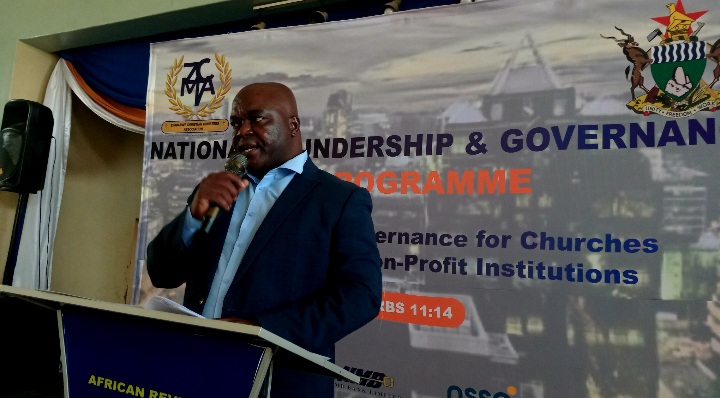
Deputy Director Coordinator In the Office of the Minister of State for Provincial Affairs and Devolution Masvingo Province, Mr Mhangure reading the speech on behalf of Hon Minister Chadzamira
By Dickson Bandera
MASVINGO – Government has reaffirmed its commitment to strengthening its partnership with the Church, describing faith-based organisations as indispensable partners in promoting peace, ethical leadership and sustainable national development.
Addressing church leaders during the Ministry Foundership and Church Governance Provincial Workshop in Masvingo on Friday, the Minister of State for Provincial Affairs and Devolution, Hon. Ezra Chadzamira, who was represented by Deputy Director Coordination in the Minister’s Office, Mr Mhangure, said the Second Republic recognises the Church as a strategic stakeholder in achieving Zimbabwe’s Vision 2030.
He said the Government’s development philosophy, “Nyika Inovakwa Nevene Vayo,” emphasises that national development is a collective responsibility requiring the active participation of Government, the private sector, traditional leaders, civil society, development partners and the Church.
“The philosophy that ‘Nyika Inovakwa Nevene Vayo’ reminds us that building Zimbabwe is a shared responsibility. Government cannot achieve this vision alone. The private sector, traditional leaders, civil society, development partners and the Church all have indispensable roles to play,” said Hon. Chadzamira.
The Minister urged churches to strengthen collaboration with Government departments at provincial, district and ward levels by actively participating in programmes that improve the welfare of communities.
“I encourage our churches to continue working closely with Government departments at provincial, district and ward levels. Understand our developmental priorities. Participate in community development initiatives. Mobilise communities around food security, environmental conservation, education, health promotion, women’s empowerment and youth development.”
“When Government and the Church pull in the same direction, communities prosper,” he added.
Hon. Chadzamira commended the Zimbabwe Christian Ministers Association (ZCMA) for spearheading the nationwide Ministry Foundership and Governance Programme, saying it complements Government efforts to build churches that are well-governed, legally compliant, ethically grounded and development-oriented.
He said the programme equips church leaders with practical knowledge in church registration, governance systems, safeguarding, child protection, human rights compliance, occupational safety and health, accountability and responsible spiritual leadership.
The Minister also called on churches to remain at the forefront of promoting peace, unity and moral values while intensifying the fight against drug and substance abuse, describing the scourge as a serious threat to Zimbabwe’s future. He urged church leaders to deliberately incorporate anti-drug messages into sermons, Bible studies, youth fellowships, family ministries and community outreach programmes.
Commenting on the recent return of Zimbabweans from South Africa following xenophobic attacks, Hon. Chadzamira applauded churches for complementing Government’s humanitarian response through acts of compassion and assistance to returning citizens.
ZCMA President Bishop Dr Christopher Choto said churches have a responsibility to comply with the laws of Zimbabwe and operate in a manner that promotes accountability and good governance. He said law-abiding churches lessen the burden on the State by reducing the need for Government to deploy resources and infrastructure to police religious institutions. Bishop Choto cited examples from Rwanda and South Africa, where stronger governance frameworks have contributed to greater order and accountability within the religious sector, urging Zimbabwean church leaders to embrace similar standards.
Governance expert Dr Makota delivered a comprehensive presentation on church governance, explaining the practical steps ministries should take to establish accountable, transparent and sustainable governance systems. He outlined the rationale behind good governance, saying it enhances institutional credibility, strengthens accountability and builds public confidence while enabling churches to fulfil their biblical mandate effectively. Drawing from Scripture, he demonstrated that principles of good governance are firmly rooted in the Bible and should guide every ministry. Dr Makota also took participants through the constitution-making process, explaining the essential components of a church constitution, including leadership structures, decision-making procedures, accountability mechanisms, disciplinary processes and the rights and responsibilities of members. He emphasised that every church constitution should contain clear succession provisions, saying leadership transitions should follow an agreed constitutional process rather than uncertainty or conflict, thereby ensuring continuity, stability and preservation of the church’s vision.
Presenting on behalf of the Zimbabwe Anti-Corruption Commission (ZACC), Mr Maringire challenged church leaders to uphold the highest ethical standards and reject all forms of corruption. He warned against allowing churches to become conduits for money laundering, human trafficking, financial fraud and illegal investment schemes that exploit unsuspecting members of the public. He said integrity, transparency and accountability should remain the foundation of every ministry and encouraged church leaders to establish governance systems that safeguard church resources and build public confidence. Mr Maringire also administered the Integrity Pledge, with church leaders committing themselves to uphold honesty, transparency, accountability and ethical leadership in the conduct of their ministries and service to their communities.
Inspector Ndlela of the Zimbabwe Republic Police delivered a presentation on safeguarding within churches, stressing the importance of protecting vulnerable members of society, particularly women and children. She urged church leaders not to conceal cases of abuse or criminal conduct but to report such matters promptly to the police and other relevant authorities while establishing safeguarding policies that create safe worship environments.
Representatives from the National Social Security Authority (NSSA) presented on pension schemes, occupational safety and health, and social security, encouraging churches to formalise their organisations and ensure that pastors, administrators and other employees are registered and protected under the country’s labour and social security legislation.
Zimbabwe Human Rights Commission Provincial Head Mr Fidelis Nyamukondiwa encouraged church leaders to uphold the dignity and rights of every individual, promote equality and non-discrimination, and foster peaceful resolution of disputes while contributing to communities founded on justice and the rule of law.
Representing the Ministry of Women Affairs, Community, Small and Medium Enterprises Development, Mrs Kaitano encouraged churches to mobilise women into organised groups that can benefit from Government empowerment programmes through skills development, entrepreneurship training, access to funding and community-based income-generating projects.
Officers from the People’s Own Savings Bank (POSB) also conducted a financial literacy session, equipping church leaders with practical knowledge on sound financial management. They introduced participants to a range of banking products and services offered by the bank, including the Huruyadzo savings product, encouraging churches and individual leaders to embrace a culture of saving, investment and prudent financial planning.
The Masvingo workshop was the third provincial engagement after Manicaland and Midlands under the nationwide Ministry Foundership and Governance Programme, which seeks to strengthen church governance, promote legal compliance and deepen collaboration between Government and the Church in advancing Zimbabwe’s Vision 2030.