By George Swarei
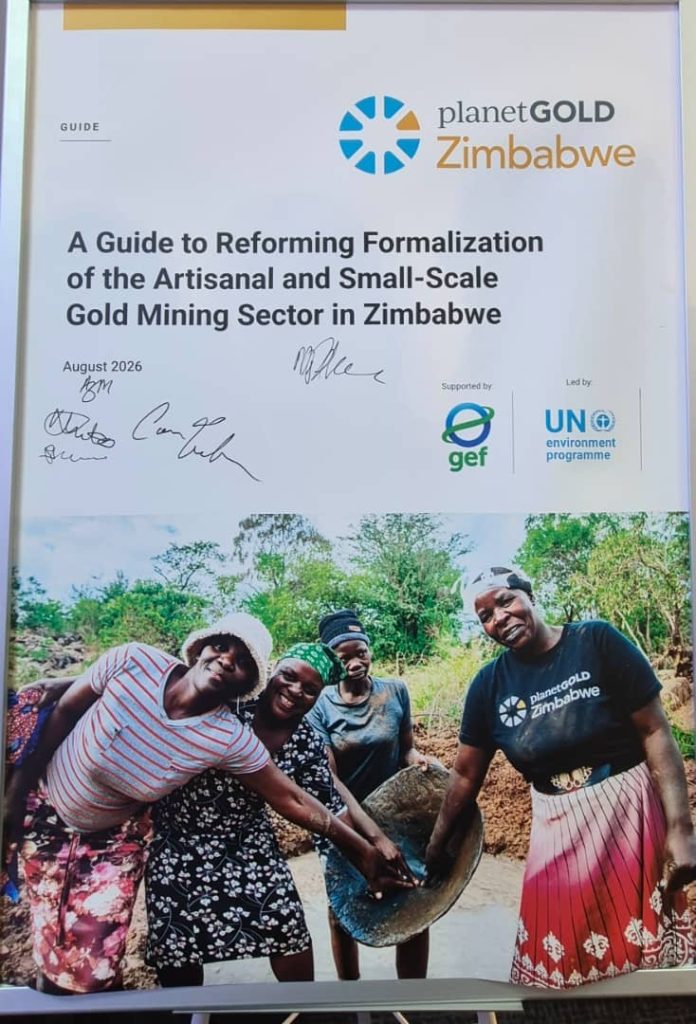
HARARE, 28 October 2026 – Zimbabwe’s efforts to bring artisanal and small-scale gold mining into the formal economy could receive a boost following the launch of a new reform guide that calls for changes to mining laws, improved access to finance and a shift towards compliance-based enforcement, while placing mercury reduction at the centre of efforts to make the sector more sustainable.
Launched in Harare on Tuesday by the planetGOLD Zimbabwe Project, the guide outlines a five-step roadmap designed to address longstanding legal, financial, technical and regulatory barriers facing artisanal and small-scale gold miners.
The initiative brings together the Global Environment Facility (GEF), the United Nations Environment Programme (UNEP), IMPACT, the Ministry of Mines and Mining Development, the Ministry of Environment, Climate and Wildlife, and the Environmental Management Agency (EMA).
The publication seeks to create conditions in which miners can increasingly operate within the formal economy, improve productivity and adopt safer gold-processing methods, while strengthening environmental management and reducing mercury use in line with the Minamata Convention on Mercury.
At the heart of the roadmap is the recognition that formalising the sector requires more than enforcement. It calls for laws that reflect the realities of artisanal mining, practical training, accessible financing, coherent gold-marketing regulations and monitoring systems that encourage compliance while holding miners accountable for harmful practices.
Five pillars for reform
The first pillar, data-driven legal reform, calls for mining legislation and regulatory frameworks to reflect the realities of artisanal and small-scale gold mining, including actual production levels, livelihoods dependent on the sector and its operational dynamics.
The approach advocates for differentiated licensing arrangements and transitional safeguards that encourage miners to comply with the law without exposing them to unnecessary criminalisation during the formalisation process.
By aligning legal provisions with conditions on the ground, the guide seeks to create a regulatory environment in which miners can operate legally and responsibly.
The second pillar, capacity building and technical training, emphasises the need to equip miners with geological knowledge, improved technical skills and environmental management practices. It also promotes the strengthening of formal mining associations to improve productivity, facilitate access to support services and encourage responsible mining methods.
A key objective is to reduce harmful practices, particularly unsafe mercury use in gold recovery. Improved technical knowledge and access to safer processing methods could help miners protect their health, reduce environmental contamination and improve gold recovery efficiency.
The third pillar, access to finance, identifies financing constraints as a major consideration in the formalisation of the sector. The guide proposes expanding access to concessionary credit, guarantee schemes and structured financial products tailored to the needs of artisanal and small-scale miners.
Improved access to affordable financing would enable miners to invest in safer and more efficient technologies, improve working conditions and reduce their reliance on informal financiers. Such support could also make compliance with licensing, environmental and operational requirements more attainable for small-scale operators.
The fourth pillar, market integration and regulatory coherence, focuses on aligning gold marketing policies with criminal provisions governing the possession of gold.
The guide highlights the need to address contradictions between regulatory and criminal law frameworks that may complicate formal participation in the gold market. Greater policy coherence would help improve gold traceability, strengthen formal supply chains and encourage miners to sell their gold through recognised and regulated channels.
The fifth pillar, monitoring and enforcement of ASGM regulations, advocates for a shift from enforcement-led suppression towards risk-based and graduated compliance mechanisms.
Under this approach, enforcement would be complemented by education, technical assistance, opportunities to correct non-compliance and appropriate accountability measures. The objective is to encourage responsible mining practices while ensuring that regulatory requirements are observed and environmental and public-health risks are addressed.
Advancing mercury reduction in Zimbabwe
The launch comes against the background of Zimbabwe’s commitments under the Minamata Convention on Mercury, an international treaty designed to protect human health and the environment from mercury pollution.
Mercury has been used in artisanal and small-scale gold mining to separate gold from ore. However, improper handling and the release of mercury vapour during gold processing can expose miners and surrounding communities to serious health risks. Mercury released into the environment can also contaminate soil and water and enter food chains.
By promoting improved technical capacity, access to safer technologies and more effective environmental management, the guide provides a framework for advancing mercury reduction within Zimbabwe’s gold-mining sector.
The collaboration involving GEF, UNEP, IMPACT, the two government ministries and EMA brings together international environmental support, technical expertise and national regulatory responsibilities around the formalisation agenda.
The proposed reforms also recognise that eliminating harmful practices requires more than enforcement alone. Miners need practical alternatives, access to financing, appropriate training and a regulatory environment that makes formalisation achievable.
The guide therefore places institutional reform, economic inclusion and environmental protection within a common framework, recognising that progress in one area can reinforce improvements in the others.
Balancing livelihoods, compliance and environmental protection
The roadmap highlights the importance of a coordinated approach involving policymakers, regulatory authorities, financial institutions, mining associations and artisanal and small-scale gold miners.
Legal reforms must reflect the realities of the sector, while training and financial support must enable miners to meet regulatory requirements. At the same time, coherent gold marketing policies and proportionate enforcement mechanisms can help strengthen accountability and build confidence in formal gold supply chains.
For Zimbabwe, effective implementation of the proposed measures could contribute to a more transparent, productive and environmentally responsible artisanal and small-scale gold mining sector.
The guide’s central message is that formalisation should not be treated simply as a process of enforcing licensing requirements, but as a broader reform agenda combining legal clarity, technical support, financial inclusion, market access and effective environmental oversight.
As Zimbabwe continues to pursue sustainable mineral development, the roadmap offers a framework for aligning the livelihoods supported by artisanal and small-scale gold mining with national development priorities and international commitments to reduce mercury pollution.
Ultimately, the success of the roadmap will be measured by its ability to turn formalisation from a regulatory requirement into a viable pathway for Zimbabwe’s artisanal and small-scale gold miners. This will require coordinated action by government, regulators, financial institutions and development partners to translate the proposed reforms into practical support, accessible financing and enforceable policies. If effectively implemented, the guide could help build a more inclusive and accountable gold-mining sector—one that sustains livelihoods, strengthens formal gold supply chains and reduces the health and environmental risks associated with mercury use. The challenge now lies in moving from recommendations to action, ensuring that the benefits of reform reach miners and communities on the ground.