
By Dickson Bandera
The Zimbabwe Human Rights Commission (ZHRC) has called for greater public understanding of intersex persons, emphasising that being intersex is a biological reality and is not the same as being “ngochani”, a Shona term commonly associated with homosexuality.
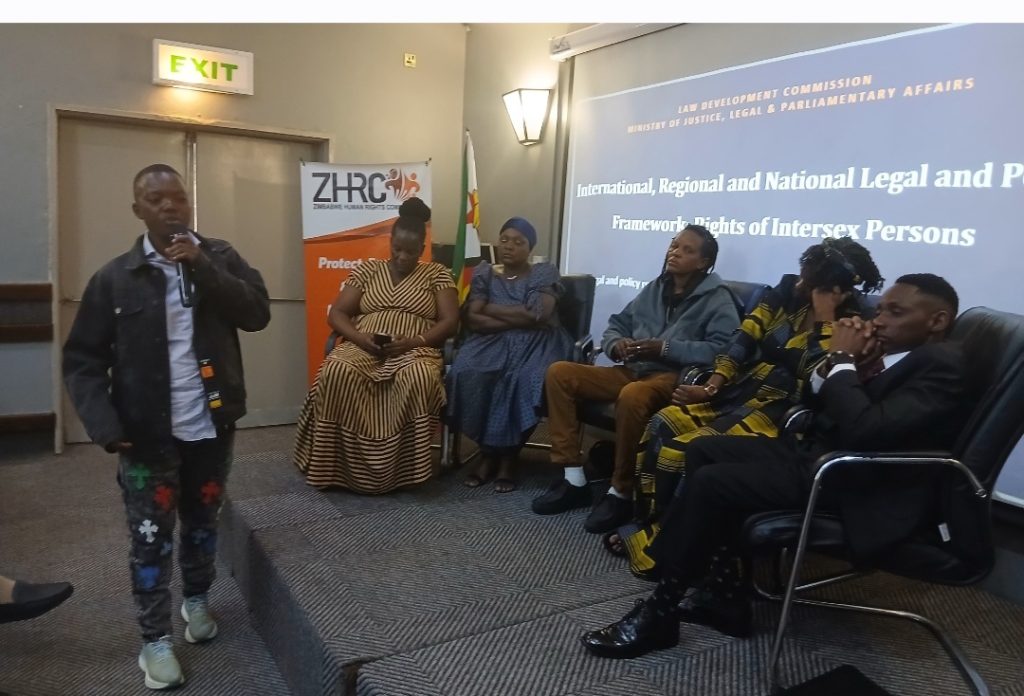
The clarification came during a community-level sensitisation dialogue on human rights and the recognition of intersex persons held at Holiday Inn in Harare on Thursday, as the Commission engaged traditional leaders, government representatives, human rights institutions and members of the intersex community.
Zimbabwe is conducting consultations to better understand the realities of intersex persons and align its policies and legal framework with global and African research seeking to recognise and protect people born with sex characteristics that do not fit typical male or female categories.
ZHRC chairperson Hon Anele Ndebele said misconceptions surrounding intersex people had contributed to stigma, exclusion and difficulties in accessing their rights, including official documentation.
“Intersex persons are born with sex characteristics that do not fit typical medical definitions of male or female bodies,” Ndebele said. “This is a biological reality, not a sexual orientation.”
The distinction is important because intersex describes variations in a person’s sex characteristics, while homosexuality concerns sexual orientation. The two terms refer to different aspects of human life and should not be used interchangeably.
Intersex variations may involve chromosomes, hormones, reproductive anatomy or genital characteristics. Some variations are identified at birth, while others may only become apparent during puberty or later in life.
Information provided by the Intersex Community of Zimbabwe (ICoZ) describes intersex as an umbrella term for people born with natural biological sex characteristics, including chromosomes, hormones, internal reproductive organs or external genitalia, that do not fit typical medical expectations for male or female bodies.
Intersex variations may be identified before birth, at birth or during childhood, while others may only become apparent during puberty or adulthood. ICoZ emphasises that being intersex is a natural form of biological diversity and should not automatically be treated as a medical emergency or a pathological condition.
The organisation is led by Kuda Murisa, a Zimbabwean-born intersex human rights defender and Executive Director of ICoZ, who advocates for justice, dignity, bodily autonomy, legal recognition and protection for intersex people in Zimbabwe and beyond.
Through community mobilisation, policy advocacy and engagement with government and other stakeholders, Murisa champions the rights and inclusion of intersex people while challenging stigma, discrimination and human rights violations.
Homosexuality, on the other hand, refers to romantic or sexual attraction to people of the same sex. The Shona term “ngochani” is commonly used to refer to a homosexual person, although its use and connotations may vary across communities.
The ZHRC dialogue sought to address such misconceptions and promote a more informed understanding of the rights and circumstances of intersex people in Zimbabwe.
Ndebele said the Commission had been engaging with issues affecting intersex persons, including through a national inquiry into access to documentation and advocacy for the protection of their rights.
He said the discussion on recognition, including the appropriate gender marker in official documents, required careful consideration and respectful engagement.
“Our shared task is to ensure that constitutional guarantees of dignity, equality and non-discrimination translate into practical protection for all Zimbabweans,” he said.
The question of documentation is particularly significant because birth certificates, national identity documents and passports are essential for accessing education, healthcare, travel and other public services.
Where a person’s sex characteristics do not fit conventional classifications, administrative processes may present challenges that require appropriate legal and policy responses.
The dialogue was convened in collaboration with the Ministry of Justice, Legal and Parliamentary Affairs and the Intersex Community of Zimbabwe (ICoZ).
Traditional leaders, including Chief Svosve, Chirau, Makore, Zimunya, Makore, Nyajena and Hata, were among the key stakeholders engaged, given their influence in shaping community attitudes, interpreting cultural practices and supporting families.
Hon Ndebele urged chiefs to help dispel misconceptions and encourage communities to treat intersex persons with dignity.
“Our traditions and our Constitution need not be presented as opposing forces,” he said, adding that traditional leaders could help guide communities towards practices that were fair, humane and inclusive.
He stressed that the engagement was not intended to pre-empt government decisions but to deepen public understanding and create space for dialogue on practical, lawful and sustainable solutions.
The distinction between intersex characteristics and sexual orientation is central to these discussions because misunderstanding the two can reinforce stigma and expose intersex people to discrimination based on inaccurate assumptions.
The Commission called for continued collaboration between government, traditional leaders, human rights institutions and the intersex community to ensure that public awareness translates into meaningful protection of rights.
“Let us listen to the intersex community, respect the concerns of our traditional leaders, and work collaboratively with Government towards practical, lawful and sustainable solutions,” Hon Ndebele said.
The dialogue places emphasis on education and mutual understanding as important steps towards ensuring that intersex persons are recognised and treated with dignity in their families, communities and interactions with public institutions.