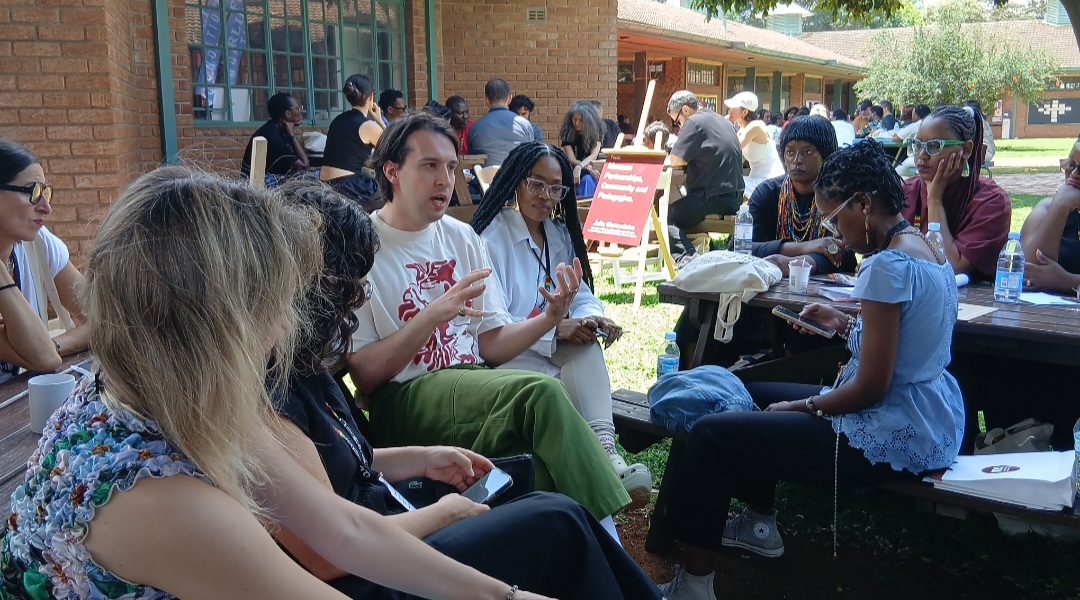
Delegates discussing on the topic Designing for Tomorrow’s Audiences: New Languages for the Future
By Dickson Bandera
Museums must rethink how they interpret, package and communicate cultural heritage, with a view of adapting to changing identities, languages and expectations of younger generations.
The challenge emerged during a Day Two breakfast-away session under the Transformation theme at the just ended 58th International Committee for Museums and Collections of Modern Art (CIMAM) Annual Conference.
The group discussion, involving 21 delegates from countries including Jordan, Zimbabwe, Kazakhstan, India, South Africa, Cameroon, Spain, Germany, Uganda and Sweden among others was stimulated by a presentation titled Designing for Tomorrow’s Audiences: New Languages for the Future, delivered by Khanyisile Mbongwa, Curator of Art in Public Realm at Amos Rex Museum in Helsinki, Finland.
A central concern was whether museums are designing exhibitions and experiences for the audiences of tomorrow or continuing to communicate through institutional languages and cultural interpretations that may no longer resonate with contemporary society.
Participants challenged curators to become more porous, flexible and receptive to new forms of cultural diversity, recognising that societies are not static and that cultural identities continue to evolve.
Christian Nana Tchuisseu, Senior Curator-Art Advisor of Musee La Blackitude of Cameroon, posed a fundamental question: what are museums designing for tomorrow?
He said preserving the past remains central to their mandate, but the continued relevance of museums will also depend on their ability to make that past meaningful to generations whose experiences, languages and cultural references are changing.
The discussion highlighted the growing influence of younger generations, whose cultural interests, artistic expressions and identities may differ considerably from those traditionally associated with their families and communities.
Increasing exposure to global culture, digital platforms and contemporary creative movements is changing how young people understand themselves and relate to heritage.
The evolution of language, particularly through digital culture, also featured in the conversation.
The discussion indicated that Social media platforms such as TikTok and the popularity of internet memes demonstrate how rapidly new expressions enter everyday communication, sometimes moving from online communities into mainstream vocabulary and eventually formal dictionaries.
This raises questions about whether museums are keeping pace with the language and cultural references used by their audiences.
Participants examined some barriers to communicating with the new generation and identified curatorial language which sometimes is too academic, specialised or confined to professional circles, making exhibitions difficult for ordinary visitors or young people to understand and engage with.
The challenge is to develop more accessible forms of storytelling without sacrificing historical accuracy, intellectual depth or the cultural significance of collections.
Projects involving schoolchildren, emerging artists and community-based creative initiatives were identified as key opportunities to recognise new talent and introduce younger generations to museums.
Exhibitions showcasing children’s artwork, for instance, can create connections between educational institutions, cultural organisations and young people while allowing emerging artists to participate in wider cultural conversations.
There were also calls for museums to remain open to contemporary artistic expressions and find ways of connecting historical collections with the experiences of present-day societies.
Such approaches require curators to be sensitive to cultural differences, changing identities and the different ways in which people relate to heritage.
Packaging emerged as an important consideration, extending beyond the physical presentation of artefacts to how museums construct exhibitions, communicate stories and make cultural knowledge accessible.
Museums must consider not only what they display, but also how they package the information and experiences surrounding their collections.