History has shown that industries rarely disappear because of technology alone. They decline when they fail to adapt to technological change.
By Placky Meck
The media industry is experiencing one of the most profound transformations in its history. Artificial intelligence is writing headlines, algorithms are determining which stories billions of people see, social media influencers are competing with established newsrooms, and audiences are consuming news in seconds rather than minutes.
The question confronting every media organisation is no longer simply, “Can we produce quality journalism?” It is now, “Can people find us before they find someone else?”
The age when media houses relied almost exclusively on loyal audiences, print circulation, or scheduled radio and television broadcasts is rapidly fading.
Today’s audience scrolls through endless streams of content generated by news organisations, governments, corporations, independent creators, and increasingly, artificial intelligence. In this crowded digital marketplace, visibility has become as valuable as credibility.
This is why marketing is no longer an optional department tucked away at the end of the newsroom corridor. It has become a strategic pillar of every successful media organisation.
Artificial intelligence is reshaping every aspect of journalism. Newsrooms are using AI to transcribe interviews, analyse large datasets, translate stories into multiple languages, generate graphics, recommend headlines, and personalise content for readers.
At the same time, AI has dramatically lowered the barriers to content creation. Almost anyone can now produce articles, videos, podcasts, and graphics within minutes. Quantity is no longer the challenge. Credibility and discoverability are.
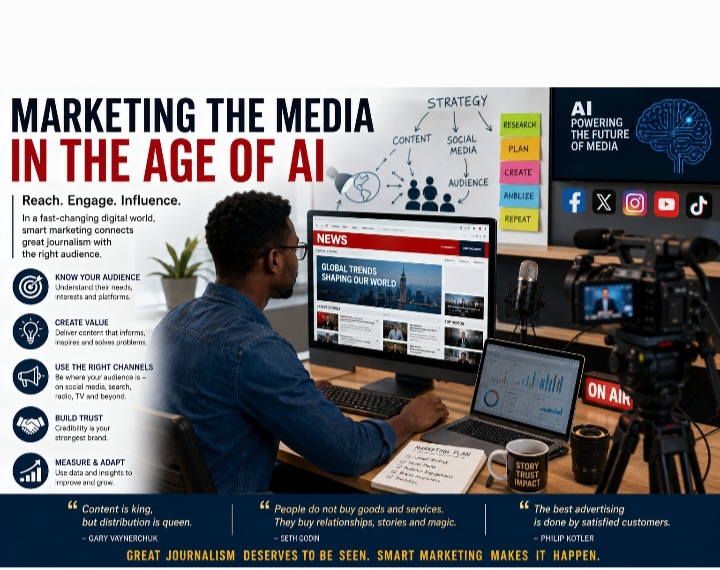
As media entrepreneur Gary Vaynerchuk famously said, “Content is king, but distribution is queen—and she wears the pants.” In other words, producing outstanding journalism is only half the battle. Ensuring that it reaches the right audience at the right time is what determines impact.
The competition has changed. A local newspaper is no longer competing only with another newspaper. A television station is not only competing with rival broadcasters.
Every media house now competes with YouTubers, TikTok creators, podcasts, streaming platforms, AI-generated content, citizen journalists, and global technology companies that command billions of users.
That reality demands a different mindset.
Marketing is no longer about selling advertising space. It is about building a trusted brand, nurturing loyal audiences, understanding data, engaging communities, and creating experiences that encourage people to return. It is about ensuring that when breaking news happens, audiences instinctively turn to your platform first.
Management thinker Peter Drucker observed, “Because the purpose of business is to create a customer, the business enterprise has two—and only two—basic functions: marketing and innovation.” For today’s media industry, those two functions have become inseparable. Innovation without marketing goes unnoticed. Marketing without credible journalism quickly loses public trust.
The role of the media marketer has therefore evolved dramatically. Today’s marketer must understand audience analytics, search engine optimisation (SEO), digital advertising, social media algorithms, video platforms, podcast distribution, newsletters, artificial intelligence tools, and emerging technologies. Creativity must now be supported by data, while intuition must be strengthened by analytics.
Yet amid this technological revolution, one truth remains unchanged: people still trust people. Algorithms may recommend stories, but trust is earned through consistency, accuracy, fairness, and accountability.
Marketing expert Seth Godin reminds us that “People do not buy goods and services. They buy relationships, stories and magic.” Media organisations that cultivate authentic relationships with their audiences will continue to thrive, regardless of how technology evolves.
Artificial intelligence should therefore not be viewed only as a threat. It is also an extraordinary opportunity. Used responsibly, AI can improve newsroom efficiency, personalise audience experiences, uncover trends, support investigative reporting, and free journalists to focus on what machines cannot replicate—human judgment, context, empathy, and ethical decision-making.
The challenge lies in adaptation. History has shown that industries rarely disappear because of technology alone. They decline when they fail to adapt to technological change.
Business strategist Philip Kotler has long argued that “The best advertising is done by satisfied customers.” In journalism, satisfied readers, listeners, viewers, and digital subscribers become ambassadors for trusted media brands. They share stories, defend credible journalism, recommend platforms to others, and become part of a growing community.
The future newsroom will look very different from the one we know today. Journalists will increasingly work alongside AI tools. Marketing teams will rely heavily on predictive analytics and audience insights. Multimedia storytelling will become the norm rather than the exception. Revenue models will continue evolving as audiences demand more personalised experiences.
But one principle will remain constant: journalism that cannot reach its audience cannot fulfil its public mission.
Media organisations must therefore stop viewing marketing as merely a commercial function. It is central to protecting journalism itself. Strong marketing ensures that credible information competes successfully against misinformation, disinformation, and the flood of low-quality AI-generated content filling digital spaces every day.
The future belongs to media houses that embrace innovation without abandoning integrity, adopt artificial intelligence without surrendering editorial judgment, and invest in marketing as seriously as they invest in reporting. In the digital age, credibility opens the door—but strategic marketing ensures people walk through it.
The newsroom of tomorrow will not simply be the one with the best journalists. It will be the one that combines trusted journalism, intelligent technology, and bold marketing to remain visible, relevant, and indispensable in an increasingly crowded world.