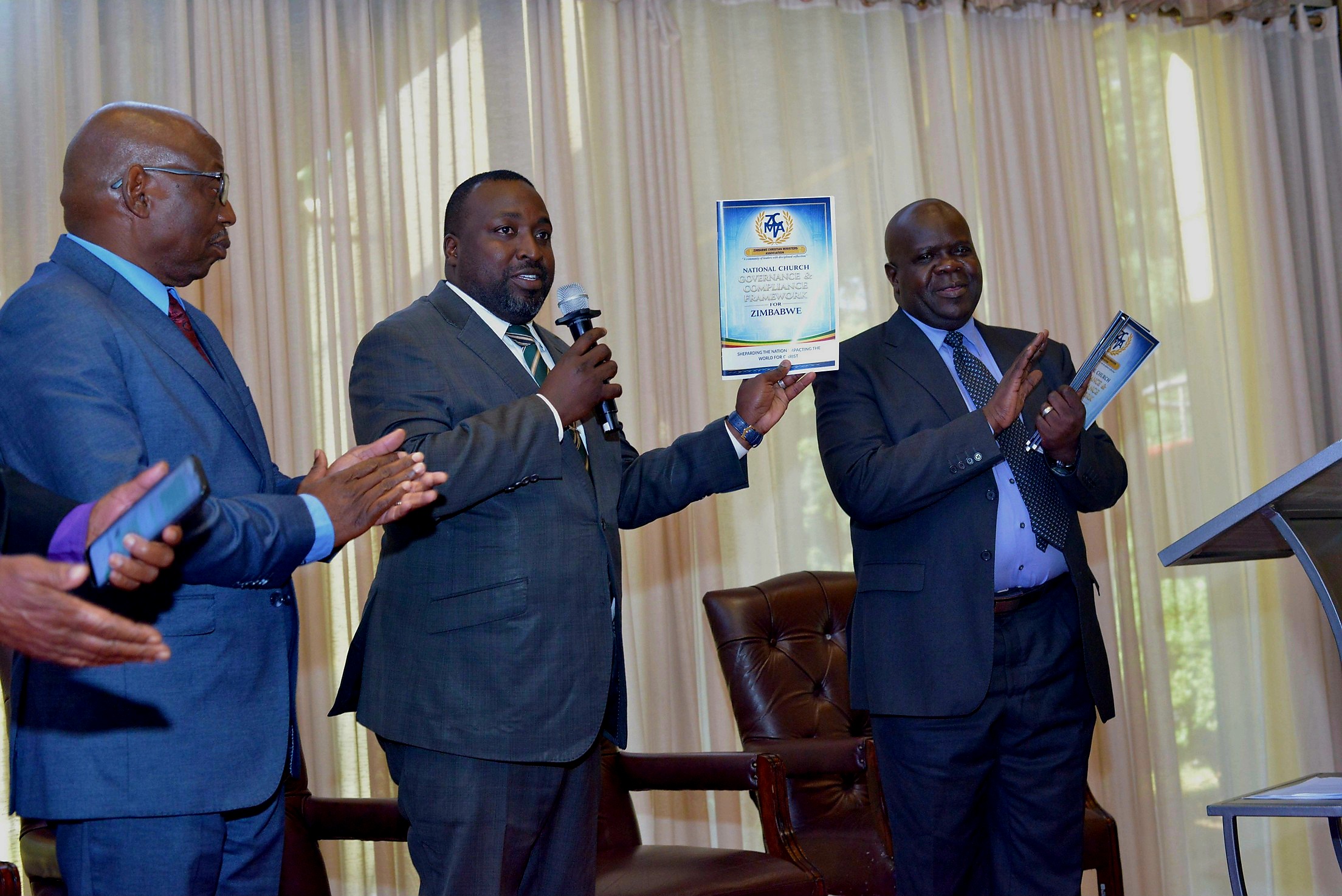
Deputy Minister of Justice, Legal and Parliamentary Affairs Hon. Nobert Mazungunye (holding the Framework) if flanked by Bishop Dr Christopher Choto (right) and Reverend Charles Mugaviri (left) during the Foundership and Governance Programme Launch in Harare
By Dickson Bandera
HARARE – The Zimbabwe Christian Ministers Association (ZCMA) is set to run a nationwide provincial roll-out of the Foundership and Governance Programme, a major church governance initiative aimed at strengthening accountability, legal compliance, safeguarding and institutional sustainability within Zimbabwe’s faith sector.
The programme, which will be implemented across 10 provinces between June and July 2026, follows the successful national launch held in Harare last month where Deputy Minister of Justice, Legal and Parliamentary Affairs, Hon. Nobert Mazungunye, commended churches for embracing governance reforms and prioritising the safeguarding and protection of congregants.
The provincial campaign is being conducted under the theme “Good Governance for Churches and Sustainable Non-Profit Institutions” and forms part of efforts to establish a National Church Governance and Compliance Framework for Zimbabwe.
The provincial schedule begins in Bindura, Mashonaland Central Province, on 23 June before moving to Marondera (24 June), Mutare (25 June), Chinhoyi (1 July), Gweru (2 July), Masvingo (3 July), Hwange (7 July), Gwanda (9 July), Bulawayo (10 July) and concluding in Harare on 16 July.
The programme seeks to promote ethical leadership, governance compliance, accountability, financial stewardship, safeguarding and responsible church administration while enhancing the sustainability of ministries and faith-based institutions.
A key feature of the initiative is the introduction of a self-regulatory framework that places church mother bodies at the centre of oversight and accountability mechanisms within the faith sector.
Organisers say strengthening the role of church mother bodies will help provide peer-led governance, uphold doctrinal and ethical standards, reduce disputes and enhance public confidence in religious institutions.
“The objective is to build ethical, accountable and sustainable ministries that contribute meaningfully to national development,” ZCMA said in a statement announcing the provincial programme.
The roll-out is expected to attract church founders, bishops, apostles, pastors, church boards, trustees, ministry executives, faith-based organisations, church administrators and chaplaincy leaders from across the country.
Government ministries and independent commissions have also been invited to participate in the programme. These include the Ministry of Justice, Legal and Parliamentary Affairs, Ministry of Local Government and Public Works, Ministry of Public Service, Labour and Social Welfare, the Reserve Bank of Zimbabwe, Zimbabwe Anti-Corruption Commission, Zimbabwe Human Rights Commission, Zimbabwe Republic Police Victim Friendly Unit and the National Social Security Authority.
The programme will cover key areas including church governance and leadership, trust registration and legal compliance, financial accountability, safeguarding and human rights, labour laws, anti-corruption measures, institutional integrity and the role of church mother bodies in self-regulation.

Church leaders and governance experts have increasingly called for stronger accountability systems within religious institutions amid growing public expectations for transparency, financial integrity and protection of vulnerable congregants.
ZCMA President Bishop Dr Christopher Choto said the programme is expected to produce stronger governance structures, improved legal compliance, enhanced financial accountability, ethical leadership, functional self-regulatory systems within church mother bodies and strengthened collaboration between churches and government institutions.
The initiative is being organised by the Zimbabwe Christian Ministers Association in partnership with the Christian Ministers Training Institute.
The provincial roll-out comes at a time when Zimbabwe’s religious sector continues to play a significant role in social development, community welfare, education, health services and nation-building, making governance and institutional sustainability critical to the sector’s long-term effectiveness.
During the launch of the programme at the Rainbow Towers in Harare last month, Deputy Minister of Justice, Legal and Parliamentary Affairs Hon. Nobert Mazungunye directly addressed cases of misconduct within religious institutions, insisting that church leadership should never be used as a vehicle for exploitation.
“We must also confront challenges with honesty. Cases of abuse and exploitation within some religious institutions are contrary to both biblical teaching and constitutional values,” he said.
“The pulpit must remain a place of hope and truth, never a platform for manipulation.”
He further stressed that ministerial authority carried moral and institutional obligations, warning church leaders against personal enrichment and unaccountable leadership.
“Church leaders must uphold accountability and transparency. Ministerial authority is a sacred trust, not a tool for personal enrichment,” he said.
Several church mother bodies and faith-based organisations have committed to ethical leadership, accountability abd good governance. These include the Chaplains of Zimbabwe, Zimbabwe Council of Churches, Federation of Independent Churches, Apostolic Christian Churches of Zimbabwe, Union for the Development of Apostolic Churches in Zimbabwe Africa (UDACIZA), Zimbabwe Network of Churches, Association of Thological Colleges in Zimbabwe, National Multi-Faith Economic Dialogue (NAMFED), Evangelical Fellowship of Zimbabwe, Patriotic Churches in Zimbabwe, Pastors4ED, Board of Christ United, Chaplains of Zimbabwe, Global Fellowship of Christian Chaplains, Bible League International, Working With People Trust, Working for All Trust and Together for All Trust.