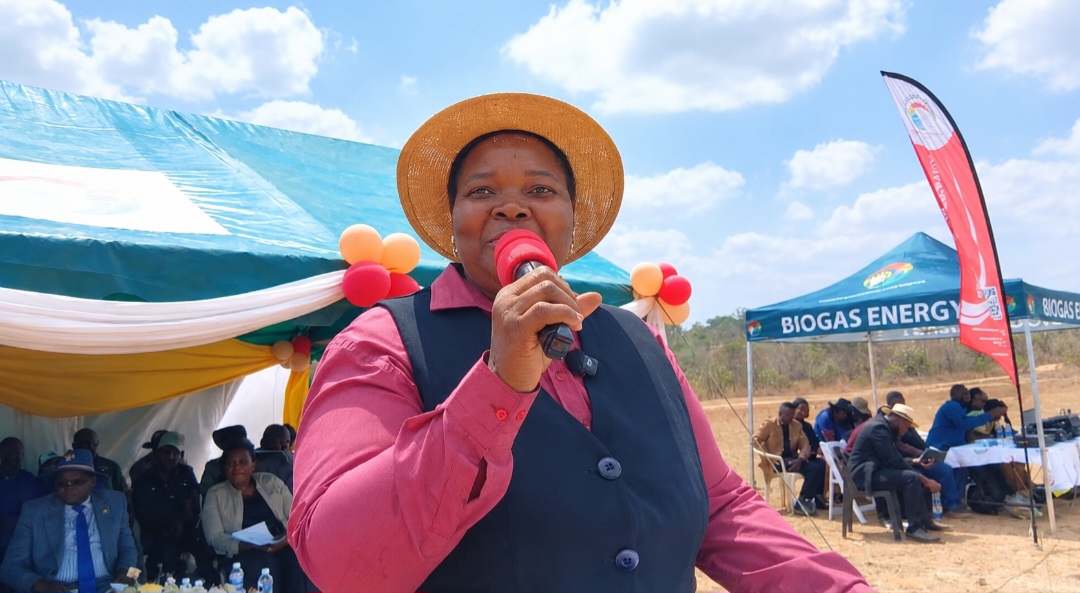
REA Board Chairperson Mrs Cecilia Chitiyo during her address
By Brenda Mazhambe
GOKWE NORTH – Midlands Province is making significant strides towards achieving universal access to modern energy services, with the Rural Electrification Agency (REA) scaling up electrification programmes under the National Development Strategy 2 (NDS2), REA Board Chairperson Mrs Cecilia Chitiyo has said.
Speaking during the commissioning of the Gandavaroyi Community Solar Mini-Grid Project in Gokwe North, Mrs Chitiyo said the project was a testament to Government’s commitment to ensuring no rural community is left behind in the country’s development agenda through the provision of reliable and sustainable energy.
“This programme we are gathered here for is a testimonial achievement of the work done by the Rural Electrification Agency in its efforts geared towards providing access to energy for sustainable development and empowerment of rural communities of Zimbabwe.
The coming of electricity in your area marks the beginning of good times ahead in our efforts to provide universal access to modern energy services to all rural communities of Zimbabwe by 2030 as enunciated in our mandate,” she said.
Mrs Chitiyo congratulated the Gandavaroyi community, saying the solar mini-grid would improve education, healthcare delivery and business operations, while laying a firm foundation for rural industrialisation.
“Allow me, Honourable Minister, to first congratulate the benefiting community on this great achievement for your schools, the clinic and business shops of having access to modern energy services provided by REA. Access to electricity is a catalyst for socio-economic transformation and will unlock new opportunities for growth and prosperity within this community.”
Highlighting the agency’s provincial targets, Mrs Chitiyo said Midlands was among the provinces receiving priority attention under REA’s nationwide electrification programme.
“Here in Midlands Province, REA is targeting to provide energy to 161 primary schools, 35 secondary schools as well as one clinic by December 2026. A total of 128 primary schools and 32 secondary schools will be electrified through grid electricity, while an additional 33 primary schools, three secondary schools and one clinic will benefit from solar energy.
These interventions demonstrate Government’s commitment to ensuring that every child learns in an electrified school and every rural community has access to modern energy services.”
She said the REA Board had approved a ZIG7 billion budget for 2026 in line with the National Development Strategy 2, with the bulk of the funding directed towards expanding rural electrification infrastructure.
“Honourable Minister, the successful implementation of REA projects across the country is guided by the availability of funding. This year, the Rural Electrification Fund Board approved a ZIG7 billion budget crafted in line with National Development Strategy Two to fund all activities during the 2026 financial year.
About 79 percent of the budget, amounting to ZIG5.6 billion, has been earmarked for electrification projects, mainly schools and clinics, with the resources being distributed equitably among the country’s eight rural provinces.”
Mrs Chitiyo said the investment would accelerate Government’s drive to complete the electrification of all public institutions.
“By the end of 2025, REA had electrified 8 383 schools and clinics out of a total of 10 773, leaving a remainder of 2 390. Work to electrify the remaining institutions through both grid extension and solar systems commenced in January 2026 and we are working tirelessly to ensure that every remaining institution receives electricity.”
She said implementation of the Rural Energy Master Plan (REMP) had transformed the manner in which energy projects were being rolled out across rural Zimbabwe by identifying the most appropriate technology for each location.
“The Rural Energy Master Plan was developed to provide a systematic approach to the provision of modern energy services in Zimbabwe’s rural areas using both grid and off-grid solutions. The plan has worked exceptionally well in selecting the mode of power suitable for different areas in rural Zimbabwe, ensuring that communities receive energy solutions that are technically appropriate, cost-effective and sustainable.”
Mrs Chitiyo also acknowledged the contribution made by electricity consumers through the Rural Electrification Levy, describing it as the backbone of REA’s development programmes.
“REA extends appreciation to all electricity consumers in the country for their unwavering contribution towards the rural electrification levy paid through electricity bills. Your contribution is not just notes and coins on the electricity bill, but light in a classroom, power in a clinic and employment in the village.
The rural electrification levy remains the single most important source of funding to close the rural-urban energy gap because Government subvention alone cannot reach every corner of the country.”
She urged communities and local leadership to maximise productive use of electricity to guarantee sustainable utilisation of the infrastructure.
“Despite the progress achieved over the years, both REA and ZETDC continue to face challenges of underutilisation of infrastructure due to the lack of productive use of power. We therefore call upon local leadership to initiate community projects and programmes that promote productive use of electricity, as full utilisation of the infrastructure promotes sustainability and long-term socio-economic development.”
Mrs Chitiyo expressed confidence that, with continued Government support, adequate resources and community participation, REA would meet its electrification targets and further advance the objectives of National Development Strategy 2 and Vision 2030.