By Brenda Mazhambe
VICTORIA FALLS — Zimbabwe is set to host more than 45 African countries for the 8th Meeting of the International Solar Alliance (ISA) Regional Committee of the African Region, with the country using the high-level gathering to accelerate the adoption of solar energy and strengthen renewable energy capacity across the continent.
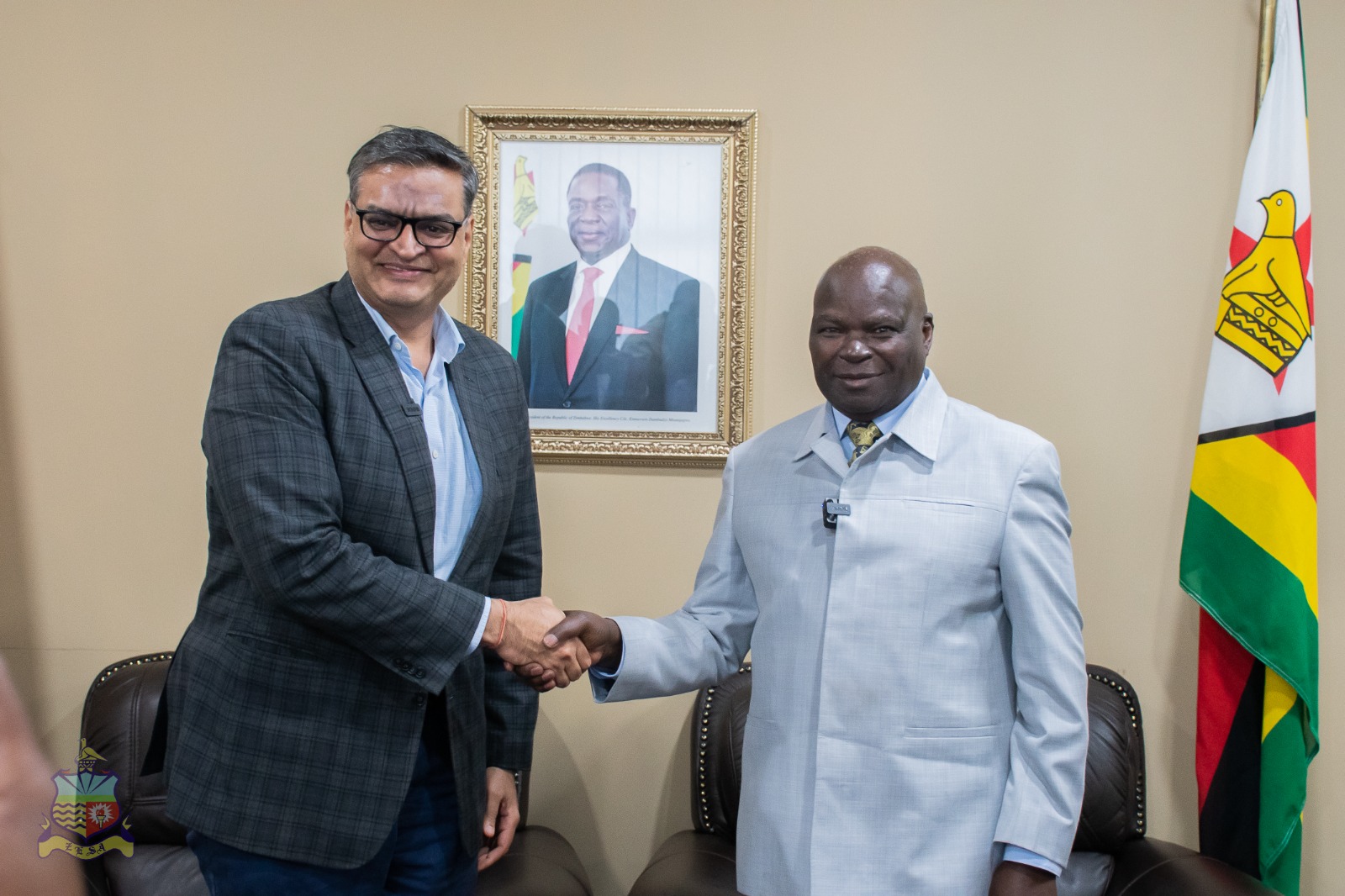
The meeting, which runs from August 25 to 27 at Elephant Hills Hotel in Victoria Falls, was preceded by a press conference yesterday addressed by Minister of Energy and Power Development Hon July Moyo and ISA Director General Mr Ashish Khanna.
The gathering comes at a time when Zimbabwe is seeking to increase the contribution of solar and other renewable energy sources to its electricity generation mix, with Government targeting renewables to account for 27 percent of total electricity supply by 2030.
Hon Moyo said Zimbabwe was honoured to host the regional meeting, describing it as an important opportunity to advance the country’s solar ambitions at a time when climate change was placing increasing pressure on conventional sources of electricity generation.
“I take this opportunity to welcome my brother from India, but he represents the International Solar Alliance, which is an international organisation. I want to welcome the minister, the Honourable Minister from Djibouti, who has come to attend this meeting which is organised by the International Solar Alliance.
“As Zimbabwe, we feel honoured that you chose us to host these regional meetings that you hold here in Africa for the Africa region. We feel that holding this at this opportune time when we are talking about energy and all sources of energy is very good for us so that we can push our solar energy as part of our mix,” he said.
Zimbabwe’s energy mix currently comprises coal, hydro and a relatively small contribution from solar energy, with Hon Moyo noting that the country’s traditional balance between thermal and hydro generation had been affected by climate change.
“Our mix includes coal, which is in abundance in this country. It includes hydro, which is now a challenge because of climate change. Otherwise, we were having a balance, almost a balance, with thermal at 55 percent and hydro at 45 percent. Very little solar,” he said.
The Minister said Zimbabwe viewed the ISA meeting as an opportunity to receive renewed impetus in expanding solar generation and other renewable energy technologies as the country works towards its 2030 target.
“But we are happy that this meeting must give us an impetus to move our solar energy and other renewables to the desired level of being 27 percent of the total supply of electricity in this country by 2030,” Hon Moyo said.
He said Zimbabwe expected the regional engagement to strengthen cooperation and provide additional momentum towards achieving its renewable energy targets.
“So you are just going to give us a kick in our arm so that we can reach the objective. We expect that the number of people who are coming, the Ministers, you will have the numbers more than us because you are inviting them, although we have sent invitations also. But this is your meeting and for members of the press, if you have questions about what we are doing, you can direct them to me,” he said.
Mr Khanna said the ISA regarded Africa as a critical frontier in the global transition towards clean and affordable energy, noting that the continent possesses significant solar potential but continues to attract only a small share of global clean-energy investment.
“It is my honour to be here for the Regional Committee Meeting of International Solar Alliance being held in Zimbabwe. Honourable Minister, thank you for your warm hospitality. It is also great that Zimbabwe will host more than 45 countries of Africa coming together,” he said.
He said the ISA was a multilateral institution representing countries of the Global South, with 128 member countries and Africa occupying a central position in its programmes.
“As you all know, International Solar Alliance is a multilateral UN-style system, first one to have Global South leadership. It is an institution of Global South for Global South, headquartered in India with 128 countries as members, with Africa as one of the big focus areas,” Mr Khanna said.
According to Mr Khanna, although significant global resources were being directed towards clean energy, Africa continued to receive a disproportionately small share of investment despite possessing some of the world’s greatest solar resources.
“Two trillion dollars was spent on clean energy last year, but only two percent came to Africa, whereas Africa has 60 percent of solar radiation,” he said.
He said developments in the global energy market, including disruptions arising from the West Asia crisis, had further demonstrated the need for countries dependent on imported fossil fuels to accelerate the transition towards renewable energy.
“After the West Asia crisis, the countries who are importing oil are spending more than one trillion dollars on diesel and petrol inputs. So we are seeing a huge increase in solarisation of countries. Africa itself has increased imports of solar by 200 percent in the first six months of this year,” Mr Khanna said.
He described solar energy as affordable, climate-friendly and suitable for decentralised deployment, including through rooftop systems, mini-grids and large-scale utility projects.
“It is the cheapest, it is the most climate friendly, and it is good for everyone because it can be decentralised to solar rooftops. What we are here to say is that Africa is now ready, not only for talking, but for actually going big on Africa,” he said.
Mr Khanna said the ISA would use the three-day regional meeting to unveil its flagship report, Solarising Africa, which would focus on practical measures for African countries to take leadership in the continent’s solar energy transition.
“Over the next three days, we’ll be releasing our flagship report called Solarising Africa, which is not talking about what needs to be done because everybody knows what needs to be done. But how can Africa take leadership? Because we believe Africa now has momentum, strong political will and strong endeavour to lead,” he said.
He identified mini-grids as one of the key interventions capable of expanding electricity access in Africa, particularly among communities that remain outside national electricity grids.
“First of all, a lot of mini-grids. Six hundred million Africans do not have energy access. There is Mission 300. Solar will be the main vehicle for providing energy access,” Mr Khanna said.
He said rooftop solar and large-scale utility projects would also be critical components of Africa’s energy transition, with utility-scale generation providing opportunities to supply regional electricity markets.
“Also everybody who has a roof can have a rooftop. That’s also a very big decentralised renewable energy. Utility scale, large grid projects that can move and supply to South Africa Power Pool, headquartered in Zimbabwe. All of them are very clear action points that we will be discussing,” he said.
The ISA Director General said the meeting would also witness the signing of an Africa Solar Facility involving Africa50 and the Nigeria Sovereign Investment Authority, intended to unlock financing for decentralised solar projects.
“To do all of it, we will be signing Africa Solar Facility with Africa50 and Nigeria Sovereign Investment Authority. It is a vehicle that is going to allow local African private sector entrepreneurs to invest in decentralised solar projects through a financing vehicle that will be signed here in Zimbabwe,” Mr Khanna said.
He said the ISA was also working to strengthen Africa’s technical capacity by establishing centres of excellence capable of supporting countries in dealing with their own solar technology and implementation requirements.
“We also believe Africa must have its own capacity to deal with its own issues. For that, we have opened 10 STAR-C solar technology application resource centres, which are centres of excellence, and we are delighted that we will be opening one in Zimbabwe while we are here as the 11th one,” he said.
The establishment of the Zimbabwe centre is expected to contribute towards strengthening local expertise and technical capacity in solar technology application.
Mr Khanna said the regional meeting would further see the signing of country partnership frameworks with Zimbabwe, Senegal and Seychelles, with the frameworks expected to provide a structured basis for cooperation in policy, financing, strategy and implementation.
“All of this also requires country partnership frameworks because this requires strategy, policy, financing and local people to actually implement. So we will be signing a country partnership framework with Zimbabwe and Senegal and Seychelles as well. That’s also part of the agenda here,” he said.
He said the ISA’s broader objective was for Africa to achieve at least 200 gigawatts of solar capacity within the next five years, arguing that reliable energy was fundamental to economic development.
“The summary of all of this is that we believe Africa is ready for at least having 200 gigawatts of solar in the next five years. This is something Africa needs because no country in the history of humanity has grown without a stable and reliable energy supply. So this is something we believe solar will be critical and as a Global South institution we are here,” Mr Khanna said.
The 8th Meeting of the ISA Regional Committee of the African Region is expected to bring together African governments and energy stakeholders to deliberate on strategies for scaling up solar energy deployment, expanding energy access, mobilising investment and strengthening regional cooperation in renewable energy.
For Zimbabwe, the meeting presents an opportunity to advance its renewable energy agenda while positioning the country as a regional platform for solar investment, technology development and energy cooperation.