By Brenda Mazhambe
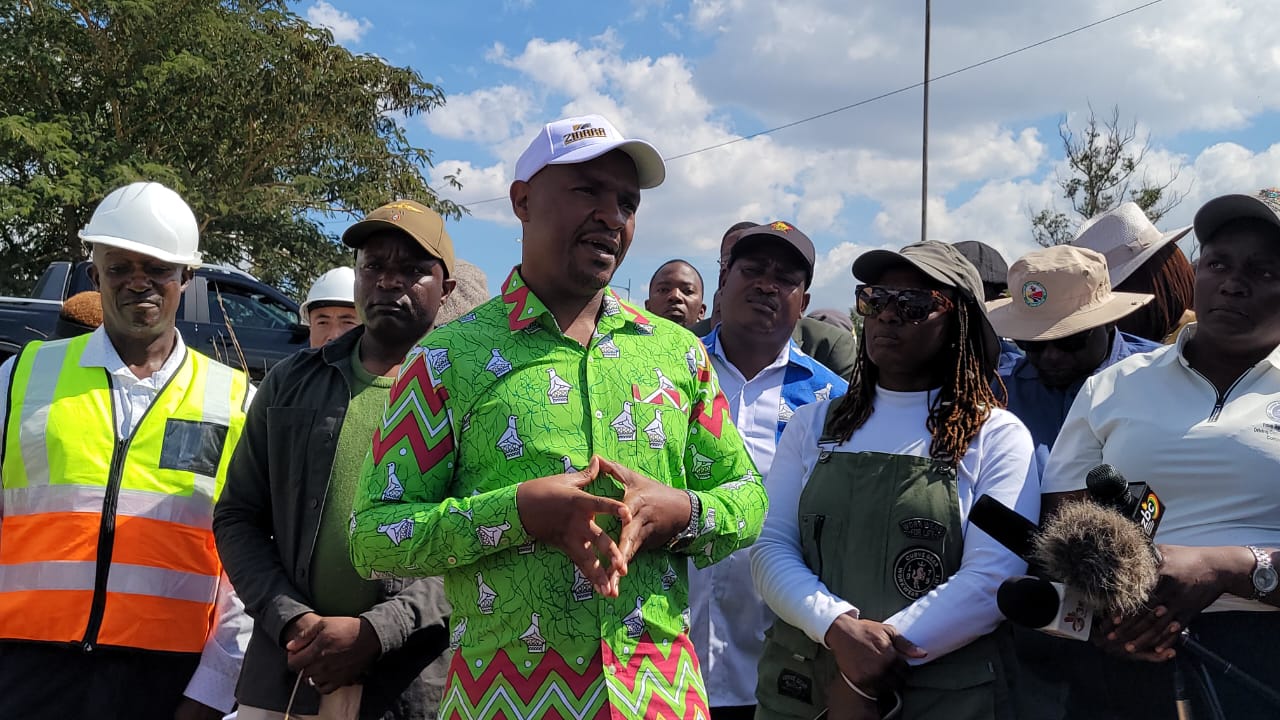
The Government has reaffirmed its commitment to modernising the country’s road infrastructure network following a tour of the construction works at the new cloverleaf interchange at the intersection of Harare Drive and Joshua Mqabuko Nkomo Road by the Minister of Transport and Infrastructural Development, Hon Felix Tapiwa Mhona, in Harare this Monday.
The transformative infrastructure project forms part of the Second Republic’s ongoing efforts to decongest some of Harare’s busiest transport corridors, improve travel times to Robert Gabriel Mugabe International Airport and enhance road safety for motorists and pedestrians.
Addressing journalists and engineers during the inspection tour, Minister Mhona said the project demonstrates Government’s continued focus on infrastructure development under the leadership of Emmerson Dambudzo Mnangagwa.
“We heard from our engineers and in particular the consultants that this is a long-awaited project that we have been talking about for years. I want to give thanks to our great leader, Comrade Dr Emmerson Dambudzo Mnangagwa, who has been championing the issues of infrastructure. You have seen that this kind of road will then enhance connectivity at the end of the day,” said Minister Mhona.
He said Government had adopted innovative funding mechanisms through private sector participation to accelerate the reconstruction and upgrading of critical road infrastructure across the country.
“We then had to go and think outside the box and engage the private sector, which is also another trajectory being driven by our great leader, that we must invite the private sector to partake in the process of reconstructing our roads and rebuilding our nation. This is one of the scenarios where we are having a loan facility and Government will then pay over a certain period of time without straining the fiscus,” he said.
Minister Mhona revealed that the cloverleaf interchange is part of a much larger road rehabilitation and expansion programme involving approximately nine to ten interchanges along strategic transport corridors.
“It is one of my projects. The entire project is valuable and has got about nine to ten interchanges. Tentatively we are talking of about US$250 million, not only for this particular interchange, but for the entire project that we are talking about, where we also have diversion roads at the end of the day,” he said.
The Minister said the road network upgrades are strategically designed to improve connectivity between major national and regional corridors.
“The essence of this project is to make sure that we enhance trafficability and connectivity as enunciated by our great leader, Comrade Dr Emmerson Dambudzo Mnangagwa. We are talking of corridors — the North-South Corridor and the Beira Corridor — where we will be connecting again to the airport, Mabvuku and Trabablas interchange. So this road infrastructure will improve the movement of people, goods and services,” he said.
Minister Mhona also stressed the importance of road safety awareness as construction progresses, saying communities and motorists must exercise caution around diversion routes and work zones.
“We also need to up our game in terms of awareness and you will see us doing that through the Traffic Safety Council of Zimbabwe. Issues of safety are very important where you also need to engage communities. We prefer that motorists navigate slowly through diversion routes and construction areas so that we preserve lives,” he said.
The Minister commended engineers and contractors for embracing a 24-hour work culture to ensure the project is completed within stipulated timelines.
“Twenty-four-seven is now the culture that we have embraced. I am happy that we are together to witness this very important project. The design part of it is also a complicated structure, but this is something that we can also do as a nation,” he said.
Minister Mhona said the specific interchange currently under construction is expected to be completed by the end of the year, while the broader corridor upgrade project is projected to be finalised within two and a half years.
“The consultant indicated that this particular project, by the end of this year, will be done. We will then move to the next phases. What the consultants have done is to have gangs working along the corridor on the nine intersections while concentrating on this particular interchange. Tentatively within two and a half years, the entire project must be complete,” he said.
He also encouraged the media to continuously monitor the progress of the works in the spirit of nation-building and public accountability.
“The Fourth Estate has an important role. Wherever you have inputs, it is not just about posing questions, but this is your own country. Let us reason together and add value for the betterment of the people. You are free to come and film the works during the reconstruction period so that citizens continue receiving updates,” said Minister Mhona.