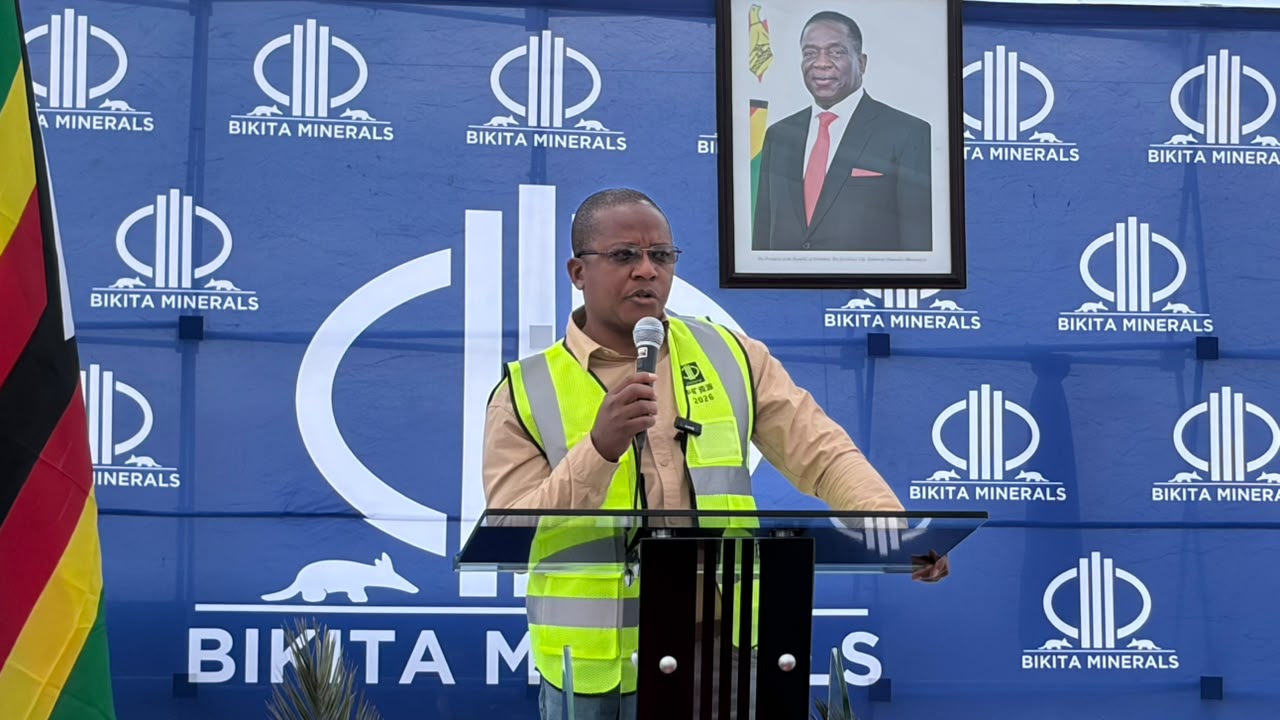
Mines and Mining Development Minister Dr Polite Kambamura
By Dickson Bandera
MASVINGO — Construction of a lithium sulphate plant that Government says will be Africa’s largest is gathering pace at Bikita Minerals, with the project expected to be commissioned next year alongside a 50-megawatt thermal power plant.
Mines and Mining Development Minister Dr Polite Kambamura said significant progress had been made at the Sinomine Resource Group-owned lithium operation as Zimbabwe implements its policy of stopping the export of raw minerals and promoting beneficiation at source.
Kambamura was speaking during a tour of Bikita Minerals in Masvingo, where he and other Government officials inspected mining, processing and supporting infrastructure being developed at the operation.
“We came here today to follow up, to check whether Bikita Sinomine complied to that call. We are pleased to note that there is a lot of work in progress,” Kambamura said.
Zimbabwe introduced restrictions on the export of raw and semi-processed lithium as part of its broader mineral beneficiation policy, requiring producers to increase processing locally and retain greater value from the country’s mineral resources.
Under the policy, lithium producers were required to make commitments towards establishing processing facilities at source, including laboratories, lithium sulphate plants and facilities capable of separating individual economic minerals contained in concentrates.
Dr Kambamura said the developments at Bikita showed that the company was making progress in meeting those requirements.
“What we have seen today is testament enough that a journey of a thousand miles can be started with a single step,” he said.
The next major development will be the lithium sulphate plant, which Kambamura said would be the largest of its kind in Africa when completed.
“Come next year, we will be seeing Africa’s largest lithium sulphate plant built here in Masvingo at Bikita,” he said.
The project will be supported by a 50-megawatt thermal power plant, which is expected to provide electricity for the lithium sulphate processing facility.
“Come next year, we will be seeing a 50-megawatt thermal power plant built here at Bikita Minerals to power the lithium sulphate plant,” Dr Kambamura said.
Government also expects the tantalum processing plant at Bikita to become operational next year, adding another mineral beneficiation stream to the operation.
“Come next year, we will be seeing the operationalisation of this tantalum plant,” he said.
The developments at Bikita form part of Zimbabwe’s broader drive to move the mining sector beyond extraction and concentrate production towards higher-value processing and refining.
The policy on mineral beneficiation is aimed at ensuring that more value is retained locally through processing, while expanding industrial capacity, creating employment and increasing the economic contribution of the mining sector.
Lithium has become one of Zimbabwe’s strategic minerals, with the country seeking to build processing capacity around its growing production of the battery mineral.
At Bikita, the expansion of processing infrastructure is expected to deepen the mine’s role in Zimbabwe’s beneficiation drive, with lithium sulphate, tantalum processing and dedicated power generation forming key components of the next phase of development.